*roundtrip ticket
One more go
ESPN.com:
Expect Steve Yzerman to announce to the Detroit Red Wings on Sunday that he'll return for one final season. The classy captain spent three hours on Friday with Wings GM Ken Holland and senior vice president Jim Devellano in Toronto, where the team presented him with a one-year offer. Yzerman, 40, was going to discuss the contract with his wife over the weekend and let the team know by the end of day Sunday, the day before the free agency market opens. Yzerman already has been invited to the Canadian Olympic orientation camp in British Columbia in two weeks and is expected to return for at least one more go-round. 'He's not going to go anywhere else,' Holland said. 'Hopefully, he'll still come back. I think he should go out playing on the ice.'
... and raising a cup.
A little perspective
Here is an instant-message conversation I just had with a Belarussian friend of mine. He’s intelligent, and extremely in touch with sentiments in his country. It offers a lot perspective into how Belarussians are reacting to the Warsaw-Minsk crisis, how they see international politics playing out, and how best to approach the situation from a Belarussian point of view. We’ll call him “Alexei”. (I have made several editorial corrections for spelling, grammar, and coherence. Anything in brackets: [*] is mine, and did not take place during the conversation. I have also censored inappropriate language. Other than the above, everything is recorded without change.) Gustav says: I'd love to know what you think about all this sh*t going down between Poland and Belarus. I bet everybody's asking you that, huh? Alexei says: Not everybody, just my wife. So far you are second. Gustav says: Well, what do you think? Alexei says: I think the Polish are not very clever. Gustav says: Why not? Alexei says: Look, you are on the street, and suddenly there is a mad dog barking at you and trying to bite your foot. What do you do? Gustav says: Beat him the hell off of my leg. Alexei says: Ignore him, try to get away. And when you are safe - make him disappear. It is stupid to pick a fight with a mad dog (or person). By doing so, you do not look clever. Gustav says: C'mon man. This can't be ignored. You can't let ethnic Poles get arrested for no reason and journalists harassed… Alexei says: I agree - not in a democracy. But Belarus is not a democracy. Gustav says: But what about when a democracy comes up against a non-democracy? That's what you have here. You're not a Lukashenko supporter, are you? Alexei says: I am not. But I am not a Polish supporter in this conflict either. I do not like hypocrisy. Gustav says: How are the Poles hypocritical? Alexei says: Its' obvious. Gustav says: Explain it to me. Alexei says: A Polish journalist the other day put it in his report from Belarus. The real victims here are Belarussians. Why no one in Poland cares about them? Gustav says: Really? I didn't see that report. What did it say? How are the Poles somehow hurting the Belarussians? Alexei says: If you have Polish passport, you are safe, you'll land in Poland. If you are Polish by nationality and Belarussian by passport - you can hope to land to Poland (though I do not believe that that a Polish chick in Belarus has any chance to get to Poland – outside of Belarus she has no value for Polish politicians). But, if you are Belarussian - you have it F*CKED UP. The most oppressed people in Belarus are Belarussians - poor and terrorized by the regime. And about the Polish - Why don't they create an alternative organization in Belarus if they care so much? They also can help financially - at least to the Polish with Belarussian passports. Instead they prefer to speak, speak, speak, and make political careers before the elections. Gustav says: But why create an alternative organization when this Polish Union was serving its purpose? It doesn't matter what organizations are set up, Lukashenko would persecute them. And why do you blame Poles for the plight of the Belarussians? I agree that ordinary Belarussians are the worst off - SO WHY NOT RISE UP? The Belarussians would receive all the international support there is - It's another Ukraine, Georgia, or Kyrgyzstan. It's not Poland's fault the Belarussians are chicken. Alexei says: Whatever the Polish do in the conflict, Lukashenko will only benefit inside of Belarus. It is very easy to be anti-Polish in my country. Half of our folklore is based around fighting Polish oppression. (Centuries of living together.) Gustav says: Surely the solution then, is to GET RID OF LUKASHENKO, and not "ignore" him. You say that whatever Poland does makes him more powerful. If they ignored him would he get weaker? Hardly. He would get stronger. Alexei says: Not inside of the country. He needs an external enemy to support his popularity. The Polish offered themselves. Stupid. (Polish politicians are stupid). My wife [who is Portuguese] also says Belarussians are chickens. You forget history. The majority of European nations went through dictatorships not so long ago. And in Belarus anyone who rose or spoke against him in the past 10 years disappeared. And people saw and see it on TV and in the newspapers. Who will do anything now? Besides, for a lot of people he is a good president (now also for all Polish-haters). Gustav says: Well, I must agree the chicken comment was out of line. But the observation about resounding international support still holds. Alexei says: There is NO international support. It is all theater.
The revolution in Ukraine cost 500,000,000-1,000,000,000 USD. Gustav says: How? What cost that much? Alexei says: Keeping people on the streets. Buying support of the army and police, etc. Ask [our mutual Ukrainian friend]. But that’s not the point. Gustav says: Ok, so everybody just leaves Belarus alone, lets Lukashenko do what he wants, and he somehow magically disappears? I don't buy that for a second. If Lukashenko didn't have any enemies, don't you think he'd be making them in order to support his popularity just as you said? In fact, isn't that what he's doing now? Isn't he picking a fight with Poland to do just that? Is your solution really to let him harass ethnic Poles and hope he goes away? Alexei says: The first thing that the "international community" should have done is to isolate Lukashenko and cut his funds (he does not keep money under the mattress). Gustav says: Well, we can agree on that. But Lukashenko is getting money from Russia isn't he? That's the biggest problem isn't it? Lukashenko won't go away until Russia wants him to. Alexei says: No, he is not. The people of Belarus work for him. Ok, his son was (may be still is) in the USA. Lukashenko is not welcome to Europe as a president. But as a private person he freely goes to ski in Austria. Inside of the country everybody knows that he gets money out of Belarus via Austrian Reiffeisen Bank. Finally, the person who set up his whole financial system lives in the UK. In reality nobody in the West wants to touch him. And all this "noise" is for the public - to keep their attention on Poland off real local problems. By the way, do you know that Belarus does not have any international or national debt? It is one of his strong propaganda points. Gustav says: But they don't have anything either! You can't have any debt if you're not buying anything! Alexei says: Again, I agree with you on this one. To develop economy they will have to borrow. Gustav says: That's not the point. Don't the Belarussians see that the reason they have no debt is because they have practically nothing? Alexei says: They do. They also see that Russians and Ukrainians and so many other people also do not have anything and have huge debt. Gustav says: Ok, I see your point. So, let's say you were the President of the US, or Poland, or Russia. If you were a major world leader, what would you do to bring Belarus into the family of democratic nations as quickly as possible? How would you solve this crisis? Alexei says: This crisis is on for 10 years already and will continue for another 30 easily. If anyone would be interested to change anything, first they would have to look at a 5- to 10-year time span. Then, speak with the Russians. Guarantee them that whatever changes in Belarus, it will always stay their field of interest. Then put mass media all around it - satellite TV channels, radio stations in Latvia, Lithuania, Poland, Ukraine, Russia. Print newspapers. And work to change public opinion in Belarus though public opinion in Russia. Gustav says: So Russia is the key... Alexei says: I am afraid yes. Russia is the key here. Gustav says: George Bush is very buddy-buddy with Putin. Do you think Putin would trust GWB if he told him that whatever happens in Belarus, it will still remain within their sphere of influence? Alexei says: No. By the way, I started to import beef jerky. Would you like to try some? Gustav says: Sure! I love beef jerky. I hated that weird fish stuff you had before though... Alexei says: Ok, next time we meet I will take some. And let’s discuss politics also then. Cheers, I have to go.
Just in case you missed it
These are the top 3 headlines right now on Radio Polonia's English language website:
The senate slams Belarus' anti-Polish policy
EC calls on Belarus to respect minority rights
Polish-Belarus relations in crisis
And the top audio file:
Poland and Belarus: from bad to worse
Well, it's not as if the country is at a standstill, but it sure seems to be all anybody can talk about. The dispute has finally found its way to Brussels, and the EU will become more deeply involved.
The problem is, nobody wants to touch Belarus with a ten-foot pole (pun intended) for fear of pissing off Russia. Brussels already has about 300 different headaches to worry about, and doesn't need another one. The Belarussians, for the most part, don't seem to really want change that much either. For these two groups, the Poles, once again, are stirring up trouble - as always.
The Poles, heady from the "victory" in Ukraine, are itching to really change things in a part of the world which is historically Polish. There are other motives too, of course. A democratic Belarus would probably be another ally in the fight against Russian dominance of energy resources in the region, it would be a buffer zone between Poland and Russia (Poles are always paranoid about being attacked by invaders. Can you blame them?), and it's a great market for Polish goods. Additionally, it's one more piece of the puzzle of Central and Eastern European countries that seem to be forming a bloc of which Poland sees itself as head. The Visegrad group comprises The Czech Republic, Hungary, Slovakia and Poland - a population of about 60-65 million people total. Warsaw would like to see Ukraine, Belarus, and perhaps Lithuania added to the group eventually as well, making the CEE countries more than able to counterbalance those ninnies in Western Europe. Oh yeah, they're also pissed because ethnic Poles are being systematically denied their rights.
The EU can't help but get involved now, and that means that soon this spat is going to be on cable television news networks and websites and newspapers tomorrow morning, or the day after.
And then people will have to take sides.
It's all quite exciting. How is this going to end?
Today's talking points
WBJ:
Deputies call for international condemnation of Belarus following recent events
Yesterday turned out to be the most dramatic day in the history of the Association of Poles in Belarus (ZPB). The regime of the country's president Alexander Lukashenko continues to increase the tension between Poland and Belarus and reached a climax point on the night between Tuesday and Wednesday when the Belarussian militia tried to enter the office of the Union by force. The country's authorities have managed to force changes in the board of the Polish organization by dismissing Anżelika Borys from the seat of the Association's head as well as seven other members of the organization. On Tuesday, on rediculous charges they detained the deputy president of ZPB Józef Porzecki, Mieczysław Jaśkiewicz and Polish journalist Andrzej Poczobut. Polish politicians are shocked about the course of events and claim that drastic steps should be immediately taken. "This is a scandal which requires a more energetic reaction and moving the issue to the international arena, at least to the forum of the EU Council in Strasbourg, but also possibly to the Human Rights Commission of the United Nations. Belarus has to be condemned not only by Poland. Other countries have to react," announced Sejm Speaker and presidential candidate Włodzimierz Cimoszewicz. When am I going to see this story in the mainstream news?
Polish PM meets with US Secretary of Defense in Iraq
Prime Minister Marek Belka spent his second day in Iraq yesterday (Wednesday), during which he met with US Secretary of Defense Donald Rumsfeld. The day before he was present at the seat of the multi-national military division, the control of which was just handed over to General Piotr Czerwiński. The fifth contingent of the Polish soldiers is also the last. Starting next year, Poles will only train the Iraqi security services. General George Casey, the commander in chief of the US army in Iraq, announced that if the political process will continue to develop and if the Iraqi security services gains strength, the Americans will significantly reduce the number of soldiers residing in Iraq in summer of next year.
Miners win improved retirement scheme following protest and Sejm vote
Following the violent protest by the workers of the mining sector, Sejm deputies yesterday decided that employees of this sector will have their own, more beneficial, retirement program. The deputies voted to allow miners the right to retire after working 25 years underground without regard to age. However, the government as well as experts criticize this decision. "Today the insurance system costs a lot because many people take advantage of it. We pay zł.14 billion for early retirements," explained Agnieszka Chłoń-Domińczak, the Deputy Minister for Social Policy. She failed however, to convince the opposition. "The miners work in extreme conditions, in hot air, humidity and have to be treated in a special way. We have to limit the expenditures, but not at the cost of the working people," claimed Maria Nowak of Law and Justice (PiS). PiS is getting more populist by the minute. Still leading in the polls - I don't like where this is headed.
Oleksy joins the growing band of resentful SLD ex-leaders
Former leader of the Democratic Left Alliance (SLD) Józef Oleksy announced yesterday that he is not interested in becoming a candidate for a seat in the Senate, although he has not yet made his final decision concerning this issue. Oleksy was annoyed at the party's authorities that they removed his right, as with Leszek Miller and Jerzy Jaskiernia, to run for a seat to the Sejm from the SLD list, but can only be a candidate in the election to the Senate. "It has been decided that I am responsible for the catastrophe of the party in the opinion polls. I am against selecting people who should be held politically responsible for the fall in support. Some people were not punished," said Oleksy, who said that tomorrow he will discuss the issue of the future of former SLD leaders with the current head of the party, Wojciech Olejniczak.
Well, Józef, you're at least partly responsible, aren't you? Shouldn't have lied about spying for the Communists in the past. Tsk, tsk, tsk.
The Guardian:
Poland May Create John Paul II Holiday
Lawmakers voted overwhelmingly Wednesday to support a measure that will establish a national day to honor the late Pope John Paul II.
The lower house, or Sejm, voted 338-3 for the bill that will make Oct. 16 a day of reflection and remembrance of the Polish-born Karol Wojtyla. That date was chosen because he was elected pope on Oct. 16, 1978. Two lawmakers abstained from voting.
The bill now goes to the Senate, which is expected to approve it this week. President Aleksander Kwasniewski is expected to sign it into law.
The annual holiday will be dedicated to remembering and studying John Paul's teachings, but it won't be a government holiday. Banks, schools and government offices will stay open.
John Paul II, who died April 2, was greatly loved and admired in Poland, his predominantly Roman Catholic homeland.
INTERESTING TRIVIA:
The head negotiator for the US in the six-way N. Korea nuclear-disarmament talks is Christopher Hill. Mr. Hill was US Ambassador to Poland during 9/11, and left his post here early last year.
Police and miners injured as union protest turns into running battle
WBJ:
Yesterday's protest of 5,500 miners in Warsaw turned into a battle with the police during which 24 policemen and seven miners were injured. The miners arrived in Warsaw to convince the Sejm to pass a retirement act prepared by the Solidarity trade union, which guaranteed the miners the right to retire after 25 years of work. The Sejm Speaker Włodzimierz Cimoszewicz did not agree to put the act to the vote, claiming, "at the end of its term the Sejm does not have the right to make decisions which may ruin the public finance system." The representatives of the miners negotiated with Cimoszewicz who ultimately agreed to meet some of their demands and to put the draft act forward for voting. However, it did not stop some of the miners initiating a battle with the police and damaging, among others, a nearby monument and two diplomatic vehicles from a nearby embassy. The police detained around 70 of the most aggressive protesters. "I want to express my regret because of what happened in front of the Sejm," stated Dominik Kolorz, the head of the miners' Solidarity trade union, "There were a 100 insane people for whom I apologize." The Sejm is to vote on the act today or tomorrow.
Leaders of the Polish Union in Belarus in police custody
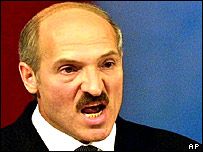 Radio Polonia Radio Polonia: Conflict between Belarus and Poland intensifies
Leaders of the Polish Union in Belarus have been taken by Belarussian police for questioning while the headquarets of the Union have been surrounded.Belarus authorities do not recognise the new authorities of the union questionning their independence.Minsk has expelled a third Polish diplomat on Tuesday describing the order as retaliation for Poland’s expulsion on Monday of a Belarus diplomat from Warsaw. Minsk accuses Poland of interference in its internal affairs and contacts with Belarus opposition. According to analysts in Poland this is not a conflict between Poland and Belarus it is rather president Lukashenko’s battle with the west. Poland should aim at evoking reactions from the European Union and show that the conflict is not an affair between Warsaw and Minsk. The Polish foreign Ministry is to present an official stand on the conflict on Thursday.
Tit-for-tat diplomatic expulsions as gulf with Belarus widens further
The WBJ:
Poland made another major symbolic move and ordered the tit-for-tat expulsion of the Charge d'Affair at the Belarusian embassy in response to expulsion of the head of the Polish consulate in Minsk. Last Friday the Belarusian Foreign Affairs Ministry issued a statement that was highly critical of Poland and Belarus state television once again accused Poland of hostile actions against the country. "The KGB and our secret services were trying to prove that they were not guilty and it was Warsaw and Polish diplomats who were the reasons behind the whole dispute," said Uładzimir Podgoł, an independent expert. The whole dispute surrounds the elections of the new head of the Union of Poles in Belarus (ZPB) in which Belarus officials are trying to push for their candidate to take the position. The officials' favorite is Tadeusz Kruczkowski, who appeared in one of the anti-Polish movies.
What is the future of the American Labor Movement?
Detroit Free Press:
Teamsters and service union to quit the AFL-CIO
Defections will be biggest labor rift since the 1930s
CHICAGO -- Jolting organized labor, the Teamsters and a massive service employees union decided Sunday to bolt the AFL-CIO, paving the way for two other labor groups to sever ties in the movement's biggest schism since the 1930s.
The four dissident unions, representing nearly one-third of the AFL-CIO's 13 million members, announced they were boycotting the federation's convention that is to begin today, a step that was widely considered to be a precursor to leaving the federation.
They are part of the Change to Win Coalition, a group of seven unions pledging to accomplish what the AFL-CIO has failed to do: reverse the decades-long decline in union membership. But many union presidents, labor experts and Democratic Party leaders fear the split will weaken the movement politically and hurt unionized workers who need a united and powerful ally against business interests and global competition.
The Service Employees International Union, the largest AFL-CIO affiliate with 1.8 million members, has spearheaded the exodus and is to announce today that it is leaving the AFL-CIO, said several labor officials who spoke on condition of anonymity.
The Teamsters plan to declare their departure at the same Change to Win news conference, officials said.
Two other boycotting unions signaled similar intentions: United Food and Commercial Workers and UNITE HERE, a group of textile and hotel workers. But they were not scheduled to take part in today's news conference, officials said.
"Our differences are so fundamental and so principled that, at this point, I don't think there is a chance there will be a change of course," said UFCW President Joe Hansen.
Without directly saying so, coalition leaders seemed to be establishing the group as a newly minted rival of the AFL-CIO. "Today will be remembered as a rebirth of union strength in America," coalition chairwoman Anna Burger said.
AFL-CIO President John Sweeney, expected to easily win re-election over the objections of the dissidents, suggested the dissidents were spoiled sports, leaving after their demands were not met.
"It's a shame for working people that before the first vote has been cast, four unions have decided that if they can't win, they won't show up for the game," Sweeney said. The rhetoric was unusually personal, in part because dissident leader Andy Stern of the SEIU is a former protege of Sweeney's.
Leaders of the dissident unions say the AFL-CIO leadership has failed to stop the steep decline in union membership. In addition to seeking the ouster of Sweeney, they have demanded more money for organizing, power to force mergers of smaller unions and other changes they say are key to adapting to vast changes in society and the economy.
Rank-and-file members of the 52 non-boycotting AFL-CIO affiliates expressed confusion and anger over the action.
"If there was ever a time we workers need to stick together, it's today," said Olegario Bustamante, a steelworker from Cicero, Ill.
It's the biggest rift in organized labor since 1938, when the CIO split from the AFL. The organizations merged in the mid-1950s.
The boycott means the unions will not pay $7 million in back dues to the AFL-CIO today, an act that some labor officials consider tantamount to quitting the federation. Still, hope for a resolution remains until the unions formally announce their disaffiliation from the AFL-CIO, officials said.
If they quit the federation, the unions would take about $35 million from the AFL-CIO, which has already been forced to lay off a quarter of its 400-person staff.
The four unions already had formed the Change to Win Coalition to pressure Sweeney to undertake major changes to the federation. That coalition scheduled a news conference this afternoon at which the SEIU and the Teamsters intend to announce disaffiliation from the AFL-CIO, officials said.
The SEIU is led by former Sweeney protege Andy Stern who has turned against his former boss.
Two other unions that are part of the dissident coalition did not plan to leave the Chicago convention: the Laborers International Union of North America and the United Farm Workers.
The United Brotherhood of Carpenters and Joiners of America, the seventh member of the coalition, left the AFL-CIO in 2002.
Leaders of the dissident unions say the AFL-CIO leadership has failed to stop the steep decline in union membership. In addition to seeking the ouster of Sweeney, they have demanded more money for organizing, power to force mergers of smaller unions and other changes they say are key to adapting to vast changes in society and the economy.
Sweeney's allies contend he has taken steps to change the AFL-CIO, meeting many of the dissidents' demands. Globalization, automation and the transition from an industrial-based economy have forced hundreds of thousands of unionized workers out of jobs, weakening labor's role.
The dissidents largely represent workers in retail and service sectors, the heart of the emerging new U.S. economy. Sweeney's allies are primarily industrial unions whose workers are facing the brunt of global economic shifts.
THE IMPACT
•On membership: The AFL-CIO will lose 3.2 million Service Employees International and Teamsters members and about $20 million in annual dues.
•On labor: Internal turmoil could draw attention from issues like organizing, raising wages and protecting health care benefits.
•On politics: A weaker labor movement could hurt the Democratic Party, its traditional political ally.
Instead of higher wages, unions need to be getting smarter. They've accomplished a lot in fighting for workers' safety and reasonable labor hours. Now, there are increasing concerns that Americans are working too much, that they don't have enough access to health care, and that American jobs are moving overseas. If the unions concentrated on these areas, they wouldn't be hemorrhaging members, nor losing out on the influence battle.
Working too much-
Compared with Europe, Americans receive precious little vacation. Instead of the typical two weeks in America, in Poland an entry-level job earns 20 workdays of vacation. After 10 years (which includes time at college), you get 26. This amount of vacation is not the reason behind Europe's recent slump - that has more to do with difficulties in hiring and firing, as well as high taxation and a high level of bureaucracy.
A few more days of vacation would be in order ...
Americans also work more than 8 hours per day, on average, if you include time on the cell phone, work at home, and skipped lunch hours (just grab some Mickey D's right? - too much work is also detrimental to Americans' health).
Labor unions need to focus (no, not necessarily on reducing work hours), but on promoting things like remote working. Due to increasing technology, people like computer programers, all sorts of writers and independent contractors, can work from home. Working from home reduces the time in the car(see, there are environmental benefits as well), reducing stress levels and time away from the family (and you can still work those 8 hours). For working moms and dads, it could be the solution to spending more time with kids. As flex-time becomes more and more popular, remote working is the next step. Unions need to work with employers and if necessary push them to find more ways to allow their workers more flexibility. That's better for workers' stress levels, their psychology, their physiology, their families, and the environment.
Health care-
This is a battle I see playing out not between the unions and employers, but between unions (and hopefully employers on the same side) and health-care providers and pharmaceuticals. Intellectual property rights need to be restricted so that drugs and health care can become more affordable. If the government isn't going to guarantee health care, then at least we can try to make it guaranteed if you work. However, as we can see in the case of GM, health care costs are now just too much for one company to handle. They need to be reduced, so that health coverage can become a viable - and ubiquitous! - benefit for workers. Undoubtedly, employees will have to cover some of the costs in the future, but we can minimize the costs to both employees and companies.
American jobs overseas/outsourcing-
I am in favor of allowing companies to move their place of production if it allows them better business opportunities. Do you like those cheap clothes? Be glad American companies are moving to China then. But this leaves lots of Americans (with highly specialized skills and with few marketable skills in the new economy) out of work, and the unions can do something about that. Instead of coming out against outsourcing outright, they should take a more long-term view. I think requiring a business to help cover the costs of retraining its workers is not too much to ask. This could be done in two ways, either by requiring the employer to pay one fee up front to help offset the cost of retraining workers (which could either be done through government programs - some alreday exist - or through private training businesses) or they pay a tax which goes to government funding for such retraining.
For an economy to work efficiently, it's got to be flexible. Investing in programs that make our workers more flexible will keep unemployment low and our economy chugging - while we buy the inexpensive raw materials and cheap goods from the countries that can do it best and cheapest.
Unions could also work towards legislation guaranteeing employee retirement benefits against corrupt or incompetent management, and adding members in middle management and new technologies, which they so far haven't been able to gain.
Or, they could keep arguing about how best to get their members more money per hour, how to prevent outsourcing from making businesses more efficient, and how to keep the Republicans out of office (something they're dreadful at) - and become extinct.
Latest parliamentary poll numbers
Angus Reid Consultants:
Law and Justice, Civic Platform Tops in Poland
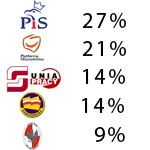
The opposition Law and Justice Party (PiS) is the most popular political organization in Poland, according to a poll by Ipsos. 27 per cent of respondents would vote for the PiS in this year’s general election, a four per cent increase since May.
Civic Platform (PO) is in second place with 21 per cent, followed by both the governing Democratic Left Alliance-Labour Union (SLD-UP) and the Self-Defence of the Polish Republic (SRP) with 14 per cent, and the League of Polish Families (LPR) with nine per cent. Support is lower for the Social Democracy of Poland (SDP), the Peasant’s Party (PSL), the Democratic Party of Poland (PD), the Union for Real Politics (UPR) and the National Pensioners’ Party (KPEiR).
On May 18, Polish president Aleksander Kwasniewski announced that the election to renew the two houses of Parliament would take place on Sept. 25. Law and Justice leader Jaroslaw Kaczynski is openly considering a coalition government with Civic Platform.
Prime minister Leszek Miller stepped down in May 2004 after Poland officially joined the European Union (EU). Miller had administered the government since 2001, but lost his majority after a split with the PSL in March 2003. Kwasniewski appointed SLD member Marek Belka as acting prime minister.
Poland currently has 2,350 soldiers in Iraq, the fourth largest contingent of the coalition after the United States, Britain and Italy. In April, defence minister Jerzy Szmajdzinski said Poland would withdraw its troops at the end of the year, when the current mandate expires. Szmajdzinski added that the mission could be extended if the United Nations (UN) Security Council or the Iraqi government request Poland to keep the troops in place.
Polling Data
What party would you support in the next election?
Jul. 2005 May 2005
Law and Justice Party (PiS) 27% 23%
Civic Platform (PO) 21% 21%
Democratic Left Alliance-Labour Union (SLD-UP) 14% 5%
Self-Defense (SO) 14% 16%
League of Polish Families (LPR) 9% 11%
Social Democracy of Poland (SDP) 6% 6%
Peasant’s Party (PSL) 3% 4%
Democratic Party of Poland (PD) 3% 3%
Union for Real Politics (UPR) 2% 2%
National Pensioners’ Party (KPEiR) 1% 2%
Source: Ipsos
Methodology: Interviews to 958 Polish adults, conducted from Jul. 7 to Jul. 12, 2005. Margin of error is 3.2 percent.
Wow! look at that jump for SLD! That's almost entirely due to Cimoszewicz's entrance into the presidential race, plus some cosmetic measures from the party.
But the best news is that ALL populist parties have slipped in the polls. Self-Defense, LPR, and PSL all lost ground. LPR (the religious far-right) slipped the most, by 3 points. Now if PO could just overtake PiS...
PO is the better center-right party, in terms of philosophy, but both of their leaders are detestable and their campaign has been a disaster. PiS has taken all the publicity, and PO is hardly ever in the news.
But some of us have a soft spot for it
Happy Birthday, Palace of Culture and Science
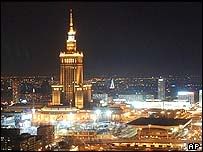
Opened: 22 July 1955
Height: 231 metres to spire tip
Contains 40 million bricks
Took three years to complete
3,288 rooms on 43 floors
16 Russians died during construction
BBC NEWS:
Poles tolerate Stalinist palace
Warsaw's Stalin-era skyscraper, the Palace of Culture and Science, is 50 years old on Friday.
But the gift from Josef Stalin to then communist Poland is also one of the country's most controversial buildings, the BBC's Adam Easton reports.
It was a gift that nobody wanted. For decades it was hated because it was the symbol of Soviet domination of the country.
It was designed by Russian architect Lev Rudniev in classic socialist realist style. Inside, it is full of marble and ornate chandeliers, but outside its stone-clad walls are home to dozens of statues of muscle-bound worker heroes with chiselled cheekbones clutching enormous hammers.
It is certainly not to everyone's taste.
"The Palace of Culture is not handsome. It's very ugly," says Warsaw's chief architect Michal Borowski, who has his office in the building.
"But it is here and it's a part of our city. You could ask is Warsaw a nice city? No, Warsaw is not a very nice city. But it is an interesting city."
Concert greats
In 1952, Russian workers were brought in to build the palace. There were so many, Polish workers had to build a makeshift "friendship" settlement of wooden cottages to house them.
We don't remember the communist times, it's only a building. Maybe it's a symbol of communism but we don't see it that way
Young Warsaw resident
A 3.3-hectare area of war-torn Warsaw was cleared to make way for the structure which contains 40 million bricks. It was completed in lightning speed and handed over to the people on 22 July, 1955.
Inside its 43 storeys there are 3,200 rooms. It was here the communists used to hold their party congresses. But it was also home to a swimming pool, a theatre, a museum and a 2,800-seat concert hall.
Over the years, stars like Marlene Dietrich, Ella Fitzgerald and a youthful Mick Jagger and the Rolling Stones performed there.
Despite the recent addition of modern skyscrapers nearby, it still dominates the city skyline. Its outline can be seen from 15km (nine miles) away.
When communism collapsed in 1989, many Varsovians thought the palace should too. That is exactly what happened in the popular Polish film Rozmowy kontrolowane (Controlled Conversations) when the main character pulled the flush of a toilet in the palace.
But attitudes have softened in the last 15 years. The political symbolism has faded. Most of the city's inhabitants, like Michal Borowski, grew up with it.
"When I was very, very young I used to go there. I learnt to play table tennis; I learnt swimming, even dancing there. During Christmas holidays thousands of children used to go there and get small gifts like three oranges, which were rare at that time," Mr Borowski said.
Mr Borowski wants to develop the area around the palace and plans to construct a modern art museum, a music theatre, shops and apartment blocks.
Sentimental value
In fact, many of the capital's younger residents - too young to remember communism - actually like it.
"It's got some sentimental value for me because my university courses used to be here. It's got a certain style. I don't like walls of glass. It's a Warsaw landmark so I think it should stay," said one.
"I like it. The architecture is funny. You don't see this style anymore. We don't remember the communist times, it's only a building. Maybe it's a symbol of communism but we don't see it that way," said another.
"I think it now has a position similar to the Eiffel Tower in Paris. It's a part of the city and it should stay. It reminds me of the Empire State Building. So, if it's used in New York, why not Warsaw?" said another woman. 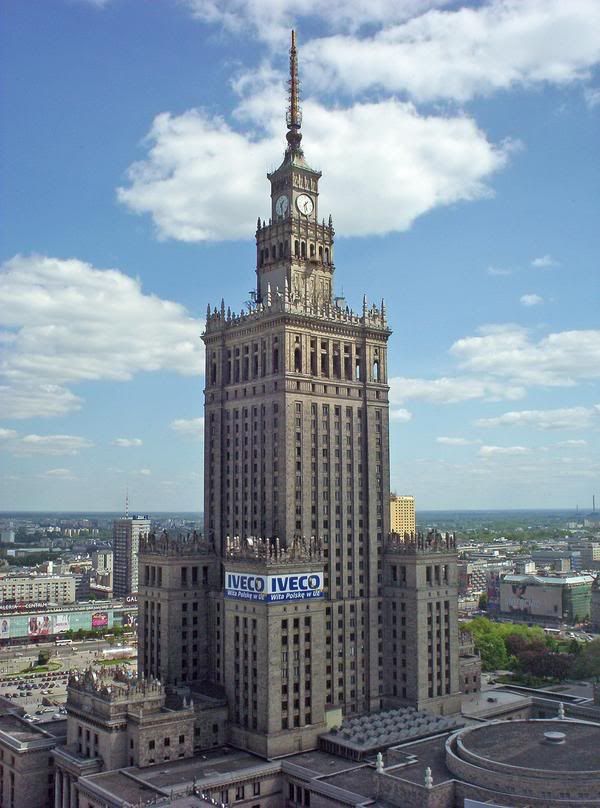
Click here to view full size
This is Kalamazoo - not Karachi - in the year 2005
Something to make me reconsider raising a family in my home country:
The Detroit News:
Evolution battle grows in schools
Michigan districts debate whether to teach intelligent design; critics call it disguised religion.
Jeff Conner knew he had to talk to school administrators when he learned his daughter was shown a video in science class that said evolutionary researchers were not scientists, and when she was assigned an essay about her beliefs on evolution and creation.
At his daughter's middle school in Gull Lake, near Kalamazoo, two seventh-grade science instructors were teaching intelligent design -- a belief that the complexity of the universe is evidence of an intelligent cause behind it.
"I wasn't happy about it because they were teaching this as science and it isn't," said Conner, a Michigan State University professor who researches evolutionary science, and believes intelligent design is too close to creationism.
The case was one of several across the country that, 80 years after the Scopes trial, has renewed the passionate debate about what public schools should and should not teach about the origins of life.
Evolution is taught in many public schools, but the U.S. Supreme Court in 1987 made lessons in creationism unconstitutional.
Since then, the intelligent design movement has gained momentum and it, along with other critics of evolution, has caused controversy in public schools in 31 states, including Michigan.
Classroom instruction and textbook usage is under siege as school leaders, scientists, politicians and people of faith continue to debate the origin of life.
Absolutely outrageous.
Intelligent design cannot be disproved, therefore, it is not science.
Period.
A hilarious sentence
Wired News:
The industry group revoked the game's M rating, which labeled it appropriate for players 17 or older, and re-filed it under AO for 'adults only' -- raising the minimum age to 18, the year at which a delicate teen becomes less susceptible to the harmful influence of computer-generated cartoon sex.
-- And we all know about the harmful effects of computer-generated cartoon sex.
I heard it causes cancer...
This is coming as a result of all this Grand Theft Auto nonsense.
When will parents take responsibility for raising their kids, and stop blaming content makers who want to help the rest of us have a little bit of sneaky fun? Would you please have a look at what your child is playing on his Playstation and would you please have a discussion with him about it, if you find anything offensive or inappropriate?
The rest of us would like to get on with our lives.
And yes, I do know that Hillary has come out against it, and I completely disagree with her.
But that won't stop me from voting for her in 2008, if I have to choose between her and some reactionary Bible-beater.
How the hell am I supposed to ever send my kids to college?
The Detroit Free Press:
All I can say is that I'm thrilled my son is 7. I've got 11 years to pump up his college fund. No more McNuggets or Transformers robots.
But parents who have a child or two in high school have got to be real edgy.
What do you do if your child's heading for college in four years? Some of the state's universities have raised tuition this year by more than 10%. What if they raise tuition another 10% next year? And the next?
What do you do? Stop eating? The brutal reality: The cost of college tuition would double in six years if a college raised tuition 12.3% each year forward. (University of Michigan tuition and fees will go up 12.3% this fall for in-state freshmen.)
Could you double your money in six years? OK, if you bought Google, you're in luck. But forget it otherwise.
"This really means you've got to look for cuts in other areas of your personal spending," said Bob Bilkie, president of Sigma Investment Counselors Inc. in Southfield.
Bilkie has three daughters. Amanda's a senior at U-M. Ashley's a sophomore at U-M. And Megan is a senior at Salem High School in Plymouth. She wants to go to U-M and later to medical school.
He'll feel a pinch. But he says he's been blessed with a good job -- and saved frugally. So he thinks he'll be OK.
Another cushion: His daughters have jobs -- and are required to save half of what they make for college extras.
"If they want to go to Starbucks, it's on their dime," Bilkie said.
What do you do if you've only got a few years to go?
•If money is tight, tell your child to consider a lower-priced college. People who don't choose U-M or Michigan State University can find jobs.
Excuse me, but F--- YOU! I'll be damned if my kids won't meet their potential because I can't bring home the dough. And by the way, U-M or MSU? Man, those are safety schools, not the ones to which I hope my kids will be aspiring. I want my kids going to private colleges with reasonable class sizes and better professors - those schools cost easily three times that of U-M. I know. I went to one.
•Forget about quick fixes -- and do not bet the college money on poker. Or stocks.
People may think they can make 10% a year on stocks. OK, remember 2000, 2001 and 2002, when people lost money?
"Equity returns are made up of home runs and strikeouts," said Fran Kinniry, principal for Vanguard Investment Counseling and Research in Malvern, Pa.
Kinniry notes: Stocks lost money one out of every four years if you look at returns from 1926 through 2004. Better short-term bets for money needed in the next five years or so: Bond funds, U.S. savings bonds or money market accounts.
•The Michigan College Savings Program may be a good option for a college 529 plan.
Savers who set aside money in the Michigan 529 can take a state income-tax deduction. All 529s aren't equal. Michigan taxpayers do not get a state income-tax deduction if they invest in other 529 plans.
•Consider the Michigan Education Trust, the state's prepaid college tuition plan. The plan is open to high school students. Enrollment begins Sept. 1. We don't know the price yet.
But if your child is in 10th grade, for example, I'd expect that you'd have to pay more than $8,750 to buy a one-year MET contract that would cover two semesters.
(I've set aside some money in the MET plan and the Michigan college savings plan. Yes, I have just one son and believe in saving for college. And we'll save more.)
•Should you plan to just borrow from your 401(k)?
I've learned to never say never, but boy, I wouldn't dream of taking money out of my 401(k) for my son.
Sure, my heart melts when I see that little boy's gorgeous smile, which is especially charming now that he's lost two front teeth. But he's not, repeat not, getting my 401(k).
Most parents shouldn't hand over their retirement cushion to cover a child's college education.
"There are other sources of money that people should look at first," said Stuart Ritter, a certified financial planner for T. Rowe Price, a mutual fund company based in Baltimore.
•Consider borrowing more money.
Take out a home equity loan, which can be tax deductible. Or a parent might consider a PLUS student loan.
Under a the federal PLUS loan program, parents can borrow money to cover any costs not already covered by the student's financial aid package, up to the full cost of attendance. So you can borrow plenty of money. PLUS loans have variable interest rates but won't go higher than 9%. The interest rate on the PLUS loan now is 6.10%.
Parents who have bad credit histories should look into a PLUS loan.
"You get the same interest rate and fee structure regardless of your credit score or history," said Martha Holler, a spokeswoman for Sallie Mae, the nation's largest provider of education loans.
If your credit history is bad, you will pay a higher rate for a home equity loan or other types of consumer loans. Not so with a PLUS loan.
•The student needs to work, look for scholarships and, yes, maybe, borrow more money.
A freshman this year can borrow $2,625 for a federal Stafford student loan. A senior can borrow $5,500. Current rate: 4.7%. But a student doesn't have to pay on the loans while in college.
Some Detroit News headlines from the past week:
Students fear tuition hikes
Wayne State hikes tuition 18.5 percent - University's board acts to compensate for an anticipated reduction in aid from the state
U-M, MSU fall tuition skyrockets - Incoming freshmen at the state's two largest colleges will pay about $1,000 more for classes
Northern Michigan increases tuition 9.8 percent
Where is this going?
Radio Polonia: Belarusian media slam Poland
The pro-government Belarusian media blame Poland and the Union of Poles in Belarus for the on-going diplomatic dispute between Warsaw and Minsk. The biggest government daily Sovietskaya Bialorusia prints a letter from a Pole who claims that the Union should serve the Belarusian state and the nation.
Head of the state committee for religious minorities Stanislav Vuko argues in another daily that the Belarusian authorities do not carry the blame for the situation in the Union of Poles. He attributes them to internal conflicts in the union.
The problems started when the union replaced its old leadership loyal to the government with new, independent-minded people.
The opposition dailies write that the authorities are afraid of a revolution. The crisis on the Warsaw-Minsk line is also analyzed in the context of the worsening of Polish-Russian relation
Poland’s foreign minister Adam Rotfeld says firmly that the problems are in Belarus and criticizes the authoritarian rule of president Alexander Lukashenko.
Two Polish diplomats have been expelled from Belarus recently. Minister Rotfeld announced that Poland will respond with a similar move.
Government Defies an Order to Release Iraq Abuse Photos
New York Times:
Lawyers for the Defense Department are refusing to cooperate with a federal judge's order to release secret photographs and videotapes related to the Abu Ghraib prison abuse scandal.
The lawyers said in a letter sent to the federal court in Manhattan late Thursday that they would file a sealed brief explaining their reasons for not turning over the material, which they were to have released by yesterday.
The photographs were some of thousands turned over by Specialist Joseph M. Darby, the whistle-blower who exposed the abuse at Abu Ghraib by giving investigators computer disks containing photographs and videos of prisoners being abused, sexually humiliated and threatened with growling dogs.
The small number of the photographs released in spring 2004 provoked international outrage at the American military.
In early June, Judge Alvin K. Hellerstein of Federal District Court in Manhattan ordered the release of the additional photographs, part of a Freedom of Information Act lawsuit filed by the American Civil Liberties Union to determine the extent of abuse at American military prisons in Iraq and Afghanistan and at Guantánamo Bay, Cuba.
The government has turned over more than 60,000 pages of documents on the treatment of detainees, some containing graphic descriptions of mistreatment. But the material that the judge ordered released - the A.C.L.U. says there are 87 photographs and 4 videos - would be the first images released in the suit. The judge said they would be the "best evidence" in the debate about the treatment of Abu Ghraib prisoners.
"There is another dimension to a picture that is of much greater moment and immediacy" than a document, Judge Hellerstein said in court.
He rejected arguments from the government that releasing the photographs would violate the Geneva Conventions because prisoners might be identified and "further humiliated," but he ordered any identifying features to be removed from the images.
In the letter sent Thursday, Sean Lane, an assistant United States attorney, said that the government was withholding the photographs because they "could result in harm to individuals," and that it would outline the reasons in a sealed brief to the court.
The A.C.L.U. accused the government of continuing to stonewall requests for information "of critical public interest."
"The government chose the last possible moment to raise this argument," said Amrit Singh, a staff lawyer with the A.C.L.U.
"Because it is under seal, we don't know whether their reasons are adequate," Ms. Singh said.
Andrew Sullivan had this to say:
A few weeks ago, I predicted on the Chris Matthews Show that more photographs of the Abu Ghraib abuses and torture would be released by the end of last month. After all, a judge had ruled in favor of the ACLU's request for the materials. The government obeys the law of the land, doesn't it? Not in this administration, which has, by presidential memo, declared the president above the law in fighting the war on terror. Now they have deployed one last, desperate tactic to keep the real truth about Abu Ghraib from reaching the public. The Bush administration first argued that dissemination of the photos would violate the Geneva Conventions. Ahem. When that failed, they argued in a sealed brief to the court that the photos "could result in harm to individuals." Like the soldiers and commanders responsible for abusing prisoners? Or the political masters who made such abuse legal? Look: I know we are at war and these photographs could inflame passions further. But they could also give the lie to the administration's claim that the prison was only the site for a handful of rogue soldiers making up rules on the night shift. They could give the lie to the notion that what happened at Abu Ghraib was merely "frat-house rough-housing." They could show rape and murder and torture - with legal cover sanctioned by White House memos. They could finally force someone to take responsibility for what happened, and for the policies that are still in place allowing for abusive treatment of prisoners. We can fight a war and remain a humane, law-abiding culture as well. We'll soon see if we still live in a country in which the president is subject to the law.
And here is some more great commentary.
We are all to blame
The New Republic Online:
The conclusion of a weeklong crash-course on Darfur by Smith College Professor Eric Reeves:
Genocidal destruction in Darfur will continue for the foreseeable future. The resources to halt massive, ethnically targeted destruction--of lives and livelihoods--are nowhere in sight. The consequences of this destruction, now extending over almost two and a half years, will be evident for years--in villages that have been burned to the ground, in poisoned water sources, in the cruel impoverishment of people who have lost everything, in deaths that will continue to mount relentlessly.
There is currently no evidence that the international community is prepared to deploy adequate protection for either Darfur's vulnerable civilian populations or endangered humanitarian operations. August, traditionally the month of heaviest rains, will see a further attenuation of relief efforts as transport of food and other critical supplies becomes mired in flooded river beds and blocked by severed road arteries. At the same time, water-borne diseases, along with malaria and a wide range of communicable diseases, will take huge numbers of lives. These diseases will be particularly potent killers because so much of the civilian population of Darfur has been seriously weakened by malnutrition. Famine conditions have already been identified in parts of Darfur, and the U.N.'s World Food Program estimates that 3.5 million people will need food assistance in the near future.
We have failed in Darfur. The only question now is the ultimate moral scale of our failure.
...
Those who would object to such a NATO deployment must answer, clearly and honestly, a fundamental question: Who besides NATO has the requisite size of forces, the logistical and transport capacity, the essential interoperability, and the experience to mount such a protection operation? The answer is certainly not the A.U., as recent months and any unbiased survey of potential A.U. capacity will indicate. The A.U. must be commended for its efforts to date; it must be encouraged to take upon itself as much of the military obligation as possible; NATO countries must accelerate the training of African military personnel and provide necessary logistics and transport on a highly expedited basis. But the A.U. cannot, in the end, be the organization to answer the desperate call of Darfur.
...
More broadly, the international community cannot allow the present "climate of impunity" (as many have described it) to prevail indefinitely. Genocide must be punished or the force of international law will be seriously compromised. Future genocidaires will be guided by the vigor and timeliness with which justice is meted out.
...
The plan I have laid out above for NATO intervention is unlikely to be implemented. Even so, it is important that the stark moral choice confronting the international community be absolutely clear. History must not record this moment as one in which our decision was uninformed by either the scale of the human catastrophe or an understanding of what is required to stop genocidal destruction.
And so, despite the long odds against an intervention actually taking place, it is our obligation to say with conviction and understanding the most urgent truth: In the absence of humanitarian intervention Darfur's civilian population, as well as humanitarian workers, will be consigned to pervasive, deadly insecurity; displaced persons will remain trapped in camps that are hotbeds of disease; agricultural production will remain at a standstill, leaving millions of people dependent on international food assistance for the foreseeable future; aid workers will continue to fall prey to targeted and opportunistic violence.
In other words, the genocide in Darfur will continue. We could stop it. We have simply chosen not to.
Europe - tolerant as always
The BBC:
Protests disrupt Latvia gay march
Latvian police have arrested protesters after they shouted insults and threw eggs at people taking part in the Baltic state's first gay pride march.
The few dozen marchers were outnumbered by hundreds of protesters who blocked the narrow streets of the capital.
Police were forced to alter the march route and to form a chain around the parade participants to protect them.
The march had sparked outrage in Latvia and only went ahead after a court overturned a council ban on the event.
Officials said that six of the protesters had been detained for their part in disrupting the march.
Prime Minister Aigars Kalvitis had opposed the event, saying Riga should 'not promote things like that'.
'For sexual minorities to parade in the very heart of Riga, next to the Doma church, is unacceptable,' he told LNT television on Wednesday.
One of those who took part in Saturday's march, 61-year-old Lars-Peter Sjouberg, from Sweden, said he had been shocked by the offensive remarks made by protesters.
'Protesters here were really aggressive [...] but it won't stop me from helping my Latvian friends fight for their rights.'
Poland's Row With Belarus To Affect Visa Policy
Radio Free Europe/Radio Liberty:
Polish authorities have suggested they could toss a Belarusian diplomat out of the country and hinted at visa troubles for Belarusians in the latest installment of a tit-for-tat row that erupted two months ago between those neighboring countries.
'The actions of the Belarusian authorities not only deteriorate the climate of bilateral relations but contain destructive elements,' PAP quoted Polish Foreign Ministry spokesman Aleksander Checko as saying yesterday.
Warsaw does not rule out a diplomatic expulsion in connection with the ouster earlier this month of Andrzej Buczak, director of the consular department of the Polish Embassy in Minsk, Checko reportedly said. Checko added that Buczak's expulsion 'cannot remain without influence on the efficiency of visa services and facilitations in traveling to Poland' for Belarusians.
Checko also stressed that Minsk's decision is tantamount to the rejection of the Polish offer of solving the ongoing Warsaw-Minsk diplomatic dispute through negotiation.
A Pattern Emerging?
A series of reciprocal diplomatic expulsions began in May when Minsk ousted Polish diplomat Marek Bucko, accusing him of interfering with activities of the Union of Poles in Belarus.
Minsk also recently denied a visa renewal to an American professor who had taught business and law classes at Belarusian State University since 2003 without offering an explanation. The professor, Terry Boesch, subsequently told RFE/RL's Belarus Service that he believes his case is part of a campaign to rid Belarus of Western influence ahead of general elections slated for 2006.
Instead of considering using Polish troops in some future operation in Palestine, why isn't Bush coming out strongly on the Polish side in this issue, further putting pressure on the Belorussian government? Bush says his goal is to spread democracy - why is so little being done to oust the last dictatorship in Europe, especially with such strong New European allies willing to step right in and do the diplomatic heavy lifting? The EU as a whole would show unbending support for such a move (meaning it could go a long way towards repairing relations). What is the reason?
One word: Putin
Injustice to Poland
The Boston Globe :
TEARS WELL in Maria Buczyk's eyes as she talks about her 83-year-old mother. ''She lives in Chicago, and she's quite sick,' Buczyk says in a voice tense with emotion. Eugeniusz, her husband, pats her shoulder comfortingly. ''I really need to see her.'
We are standing in a courtyard of the American Embassy in Poland. The Buczyks are waiting in line to apply for visas so they can travel to the United States. This is their third time going through the process; they were turned down twice before, they say, after being interviewed by consular officers who barely glanced at their documents. ''They said I was going to immigrate,' Maria recalls -- i.e., remain in the United States beyond the 90 days allowed on a tourist visa. ''It's not true. I just want a month with my mother.'
Like everyone else in line, the Buczyks are carrying a sheaf of paperwork: passports, photographs, and a nonimmigrant visa application that had to be filled out on the Internet before being printed. Because Eugeniusz is in his 50s, he didn't have to complete the supplemental application required of all men up to age 45. (Sample query: ''Do you have any specialized skills or training, including firearms, explosives, nuclear, biological, or chemical experience?') On the other hand, he and Maria have brought along additional documents they hope will bolster their application -- a letter of invitation from a US citizen and a bank statement showing their savings in Poland. But these are optional, and the embassy's guidelines candidly warn that ''the consular officer may choose not to look at them if it appears that additional documents won't make a difference.'
Definitely not optional is the final item in the Buczyks' folder -- a bank check for $100, the mandatory ''visa services' fee that must be paid by anyone who applies for a US visa. In a country where $1,000 is the average monthly income, $100 is not a trivial sum, and as the Buczyks have learned, it is nonrefundable -- the embassy keeps the money whether a visa is granted or not. Nor is that the only cost: To schedule their interview, the Buczyks had to call a special embassy ''infoline" -- a call for which they were charged nearly $1.50 per minute.
The whole ordeal strikes Poles as overbearing, insulting, and unfair. Americans have been able to enter Poland without a visa for years; why, they ask, should Poles have to go through such a demeaning procedure in order to enter the United States? Especially -- this really sticks in the Polish craw -- when Washington has waived visa requirements for citizens of nearly every Western European nation, including Great Britain, France, Germany, Belgium, and Ireland.
US consular officials reply that Poland is not being discriminated against but that it simply hasn't met the conditions stipulated by Congress for inclusion in the visa waiver program -- starting with the requirement that a country's visa denial rate be no higher than 3 percent. Currently, about 25 percent of Polish visa applicants get rejected. But the 3 percent rule strikes many Poles as a Catch-22.
Article Tools
''Why are you refusing visas? What is it based on? The criteria seem to be things like -- students who aren't married and don't have a car or property get turned down," says Marek Purowski, a spokesman for the Polish Embassy in Washington. ''So an honest student in Poland who saves for many years in order to legitimately visit the US will be rejected, and then his rejection gets held against us" as a reason to require visas.
The visa issue has become the biggest irritant in US-Polish relations. ''It cuts across all layers of Polish society," says US Ambassador Victor Ashe. ''From the hotel chambermaid to the business executive, every Pole is familiar with this issue." With more than 9 million Americans of Polish descent, many Poles feel a particular kinship with the United States. That kinship has been reflected in national policy: At a time of rising anti-US sentiment, Poland has been notably pro-American.
Especially on Iraq. Not only did the Poles resist French and German pressure to be ''good Europeans" and oppose the war, they contributed more troops to the US-led coalition than any other European country except Britain and Italy. Naively, perhaps, they expected their support to be rewarded, and Washington's refusal to ease the visa requirement is widely interpreted here as ingratitude.
Sure, there are good reasons not to exempt Poland from the existing visa regime. But there is an even better reason to consider doing so, at least on a trial basis -- a reason articulated best by George W. Bush. ''Listen," the president told reporters in February, ''Poland has been a fantastic ally." Indeed it has. And in statecraft, as in private life, special friends deserve special consideration.
Globalization isn't always bad...
The WBJ:
PPM’s Danish takeover means meaty investments, succulent job prospects
PPM Agros Koszalin, a meat producer which went bankrupt two years ago, is to be taken over by a Danish investor. The name of the investor has not been revealed, but it has been said that the Danish company plans to start up the production line as soon as possible, irrespective of huge investments that will be involved in restructuring PPM and bringing it back on the market. They also plan to change the company's profile, and become a part of the fish rather than the meat processing industry. Additionally, they plan to hire about 700 people, which is a lot compared to the previous 400 employees. President of the Polish association of the fish processing industry, Jerzy Safader, thinks that a new Danish investor should not threaten the domestic market, as the product coming out from the Polish plant will be sold in Denmark's outlet markets. Moreover, the domestic fish processing industry is competitive in foreign markets with exports of EUR 400 million a year.
Thoughts for the day
1. The disaster that is Poland's public health system enters a new chapter
Warsaw Business Journal:
Minister calls for NFZ officials to resign
The conflict between two state institutions managing the health sector seems to have reached a climax, as Health Minister Marek Balicki is demanding the dismissal of the president of the National Health Fund (NFZ) Jerzy Miller. "I will not comment on this now. I will call a press conference before the meeting of the Fund's council," announced Balicki. Miller also declined from commenting on the situation. The decision whether he should keep his job is now up the the NFZ council, which according to unofficial information supports its boss. The direct cause of the conflict between the institutions is the NFZ's money. According to Balicki, the Fund has over zł.400 million of surplus cash which it plans to spend right after the parliamentary elections so that the public would acknowledge an immediate improvement of the situation of the health care system. "The funds should spend the money on treating people now, patients cannot wait," Balicki warns.
The health system crisis is the most important issue facing Poland, and none of the politicians are touching it before the elections.
2. It is now clear that 3 Poles died in the London bombings of 7/7.
3. GM has released more bad news. A loss of over $286 million despite rising sales and gaining market share. Gustav's prediction: GM will move most of its manufacturing to Alabama and other southern states, as well as Mexico, as soon as its contracts with the unions allow. Michigan's economy will tank.
Free Press story
New York Times story
3. Poland's economic ties with Iran are growing:
Poland joins Iran’s ardent gas customers
WARSAW (Reuters) -- Poland's natural gas monopoly PGNiG is in talks to help build a pipeline that would bring gas from Iran and Turkmenistan to the European Union, seeking an alternative to Russian energy supplies, its CEO said this week.
Marek Kossowski said PGNiG -- the last major central European gas firm still in state hands -- was in talks with a consortium of energy companies seeking to extend the Nabucco pipeline to carry gas from central Asia via Turkey to Austria.
"We are living in such times that all diversification of supplies is very beneficial, especially in light of terror threats," Kossowski said in an interview. "We are interested in the Nabucco pipeline and are already in talks with the consortium that is building it. We are ready to join this project financially and as a client, which can guarantee stable demand for gas from the pipeline."
read the rest
4. Poland and the US' defense relationship gets stranger:
Radio Polonia:
Poland to receive $100 million aid
Polish and American defence ministers met in Washington to discuss the details of US military aid. The promised 100 million US dollars will be used for modernization of Polish army – among others training of Polish fighter pilots and purchase of Hummer armed vehicles. The meeting was the final part of Polish Minister’s visit, Jerzy Szmajdzinski visited also the naval base Norfolk, Virginia, National Defence University and met a group of senators in Washington. Mr Szmajdzinski refused to comment on information that Polish soldiers could be sent to Gaza strip as a part of peace-keeping mission.
Excuse me, but holy shit! When did the Poles sign up for this? Could it just be an ugly rumor?
This $100 million in aid comes despite this controversy:
Warsaw Business Journal:
US media questions Bumar's Iraqi contracts
Arms manufacturer Bumar has so far managed to sign 35 contracts with Iraq for the delivery of military supplies, worth a total of $400 million. This result might have given grounds for the company to give itself a pat on the back, but instead have led to critical remarks in the American media. US-based newspapers belonging to Knight Ridder Newspapers, one of the largest press distributors, declared that the former Iraqi government signed unbeneficial contracts and lost as much as $300 million on them. The reasons for the losses were also due to alleged corrupt propositions from Bumar. A group of Iraqi inspectors came to Poland in order to check a fleet they ordered, which was to be renovated, and cost the government $100 million. What they found were 24 thirty-year old helicopters from the soviet era. The disappointed team refused to accept the fleet and returned home empty handed, writes the American press. "We have signed a contract for the delivery of 24 used helicopters Mi-17. The contract said that these can be manufactured between 1974-92. The Iraqi inspectors initially highly evaluated the equipment and informed us that they do not have the rights to sign the protocol to collect them," announced Bumar president, Roman Baczyński.
5. The Pistons are hiring Flip Saunders to replace Brown. Fine. All I know about him is what I've read today, but I trust Joe Dumars' judgement.
ESPN.com story
6. Prince Bandahar is retiring as Saudi ambassador to the US. He'll be replaced by the current Saudi ambassador to Britain. Here's what was written in the NY Times about Prince Turki:
"Yes, he knew members of Al Qaeda," an American official said. "Yes, he talked to the Taliban. At times he delivered messages to us and from us regarding Osama bin Laden and others. Yes, he had links that in this day and age would be considered problematic, but at the time we used those links." The official said that Prince Turki seemed to have "gotten out of that business" since 2001 and that "he understands that times have changed." story
But really, Prince Bandahar looks like an Ewok, doesn't he?

6. From CNN today:
Ex-officers: CIA leak may have harmed U.S.
WASHINGTON (AP) -- Eleven former intelligence officers say the leak of CIA officer Valerie Plame's identity may have damaged national security and the government's ability to gather intelligence.
The former officers made their views known in a three-page statement to congressional leaders.
They said the Republican National Committee has circulated suggestions for officials to deal with the Plame case by focusing on the idea that Plame was not working undercover and legally merited no protection.
Thousands of U.S. intelligence officers work at desks in the Washington area every day whose identities are shielded, as Plame's was when her identity was leaked by Bush administration officials, the 11 former officers said.
I'm still not convinced it was Rove who actually leaked the name to reporters, but whoever did put US security in jeopardy, and ought to be punished. That Plame was in Washington is no excuse, because an experienced field agent is now unable to perform duties in the field should she be required to do so, and her former contacts may be in danger. If you had been one of her contacts, how eager would you be to continue cooperation with the CIA? Not too eager, I imagine.
Just another day in Warsaw
Check out this post on a blog called "Idle words". Hilarious and very accurate. Especially for gun and law-enforcement enthusiasts.
Speaking of integration - Polish immigrants in Texas
The Bandera Bulletin:
Our Polish heritage: rugged individualism and community spirit
As the St. Stanislaus parish celebrates its 150th anniversary, much is being written about the first Silesian families who settled in Bandera in 1854. Today people marvel at their courage, resourcefulness and determination to succeed in a new country that was a hostile wilderness. Looking at the background of these people can help us understand how they overcame the hostilities of the frontier. Their experience contributes to an understanding of how Bandera developed into a unique Hill Country town.
The homeland of what we call the Polish immigrants was [and still is...] known as Silesia. In the 1800s it was under Prussian control. Despite the fact that the region had been separated from Poland for over five hundred years, it had a strong Polish identity.
The culture of the region was a rich blend of east and west; people were constantly interacting with many ethnic groups who spoke different languages. German was the language used for business, while Polish and various dialects were used at home. Many of the Texas immigrants spoke German and Polish, as well as the Silesian dialect. Those in the first wave of immigration to Texas were educated people who typically were land owners in Silesia. They were in a social class between the gentry and laborers.
Silesia was known as a poor region. When natural disasters occurred, such as droughts and plagues, the people of Silesia were often the hardest hit. Difficult economic conditions, mandatory military service in the Prussian Army for men of ages 20 to 40, epidemics of typhus and cholera, increasing crime and devastating floods were some of the hardships the people of Silesia endured during the 1800s. One ironic coincidence is that all of the regions the Silesian immigrants came from were subject to periodic flooding.
The area was predominantly Catholic, and their deeply held religious beliefs sustained them for centuries. When letters from Father Moczygemba in Texas, a priest from their own region, reached them, the Silesians were predisposed to accept his claims of opportunity in Texas. From 1852 to 1854, Father Moczygemba was assigned to the town of New Braunfels, where he saw German immigrants prosper in an open society. In 1854 he moved to the Alsatian community of Castroville, where again he witnessed the success of European immigrants. His letters inviting people to come to Texas for a better life were treated as gospel. As the Silesians reacted positively to his letters, Father Moczygemba selected two areas for the relocation of the Silesians, one in an unnamed area in Karnes County and the other in Bandera.
When a family decided to emigrate, the head of the household had to petition the King of Prussia for permission to leave the country. Single women needed the permission of their fathers to be included in the petition. When a Document of Dismissal from Prussia was issued, the rights of being a Prussian citizen were forsaken.
Offsetting the difficulties of selling their possessions and saying good-bye to family and friends were the promises of their own church, free land and economic opportunity waiting for them. Speculating about the new country was one way to get through the arduous two-month sea voyage.
The Weser, which was the first ship to bring the Silesians to America, landed at Galveston on December 3rd, 1854. A small group of Silesians followed a few days later on the Antoinette. The 159 Silesians then went by boat to Indianola, where they progressed on foot or in carts to San Antonio, where Father Moczygemba met them. He led most of the group to the area that would become known as Panna Maria.
Knowing that the families going to the more dangerous site of Bandera would have to be self-sufficient, the priest selected families according to the skills of the men, hardiness of the women and ages and sex of the children. In February 1855, they were taken by teamsters in ox carts to Bandera, where jobs had been secured for them in the James and Montel sawmill. The drivers were instructed to take anyone into Bandera for free, but they were prohibited from taking any one out of Bandera.
While they had no way to leave Bandera, after giving up their homeland and suffering the hardships of the journey, it is unlikely that any of the Silesians would have considered leaving. They had no other dream to pursue.
The influx of Silesians to Texas occurred in a three year time period, 1854 to 1856. The Texas drought of 1856 and 1857 halted further immigration. Despite the hardships, the Silesians established colonies, churches and schools. In Bandera, while language, customs and dress may have distinguished the Silesians from other townspeople, the town was so small and the hardships of living on the frontier so great, all of Bandera's citizens had to work together to survive. This was especially true in times of crisis.
The same can be said of present-day Bandera. The town continues to attract unique individuals who pursue their lives with minimal interference. But, when a crisis occurs, the outpouring of assistance is overwhelming. Many towns in the Hill Country are known for the predominance of one ethnic group. Fredericksburg and New Braunfels are German; Castroville is Alsatian. Bandera remains an eclectic group of individuals. The first Silesians-or as we now know them, Polish-offer to us an example of how to live with dignity in hardship, and how to survive and flourish with faith and hard work.
Map of Polish regions here
|
One more go
Если вы любитель онлайн казино 2020 года то, [url=https://bbl-company.ru/]бесплатно полученный товар[/url], вероятно, заметили, что онлайн-казино приобрели популярность в последние годы. Онлайн-казино дает игроку возможность играть во все свои любимые игры дома и вдали от своего компьютера или даже смартфона. На этой странице вы найдете плюсы и минусы онлайн-казино, а также казино в России, которые лицензированы и позволяют вам наслаждаться магией и бонусами казино, не предлагаемыми реальными казино.
A little perspective
Just in case you missed it
Some background:
WBJ:
There are 400,000 Poles living in Belarus, of which 20,000 are members of a minority organization that has recently become a bone of contention between Alexander Lukashenko’s party and the Polish government. The conflict erupted when the Union of Poles in Belarus elected Andżelika Borys as its new head. Her main flaw? She is not Tadeusz Kruczkowski – the former, pro-Lukashenka leader of the Polish minority – such an independent nomination could not be taken lightly by Europe’s last dictator, especially in light of Polish support for uprisings in Georgia, Ukraine and Kyrgyzstan.
The headquarters of the Union in Grodno were closed for members, and those who continued to engage in the organization’s activities – such as a Polish folk concert – were arrested. A couple of days ago Belarusian militia knocked on Andżelika Borys’ doors in the middle of the night,and she only escaped imprisonment by refusing to let them in and warning that she would inform the international media. If there is one thing Lukashenka is worried by, it is more bad PR.
The arrests, Soviet-style lawsuits and finally the storming of the Union of Poles’ offices by Belarusian special forces seriously harmed diplomatic relations between Minsk and Warsaw. There were expulsions of diplomats on both sides and fierce demonstrations in front of the Belarusian embassy. In order to deal with the crisis, Polish Foreign Minister Adam Rotfeld summoned his ambassador from Minsk. Belarusian authorities accused Andżelika Borys of fraud. As the WBJ was going to press, the conflict remained unresolved.
National Legal Internet Portal (press release), Belarus:
Foreign ministry: recall of ambassador of Poland shows that Poland is pursuing policy for exacerbating and suspending relations with Belarus
Today’s decision of the Polish authorities to recall their ambassador from Minsk shows that Poland is pursuing a policy aimed at exacerbating and suspending its relations with Belarus, official of the foreign ministry’s press service Maria Vanshina told BelTA.
Maria Vanshina underlined that the foreign ministry of Belarus drew attention to it in its statement of July 22, 2005. “The step undertaken by Poland demonstrates the lack of its intentions to seek for the way out of the crisis and work for strengthening good-neighbor relations”, Maria Vanshina stated.
At the same time she noted that the embassy of Belarus in Poland will continue strengthening mutual relations between the two countries.
Today's talking points
Just when I ask when I'm going to see this story in the mainstream media...
BBC News:
Belarus-Poland dispute escalates
Poland has recalled its ambassador from neighbouring Belarus amid escalating tension between the Polish government and Belarus' president.
President Alexander Lukashenko has accused the Polish minority in Belarus of plotting to overthrow him.
On Wednesday, Belarussian police raided the headquarters of an organisation representing ethnic Poles in Belarus and briefly detained its leader.
Each country has expelled the other's diplomats in recent months.
About 400,000 ethnic Poles live in Belarus, in areas that were part of Poland until World War II.
Mr Lukashenko has accused Poland of interfering in Belarussian affairs and seeking to provoke mass protests against his government.
Poland says Mr Lukashenko's government is persecuting the Polish community.
Fears of backlash
Riot police with guns and dogs raided the Union of Poles headquarters in the western town of Grodno, about 280 km (175 miles) west of the capital, Minsk, on Wednesday, detaining those inside for several hours.
Mr Lukashenko has criticised the recently elected leadership of the association, saying it is illegal.
Some Poles outside the building on Thursday said they feared rising anti-Polish sentiments among the Belarussian people.
"The authorities of Belarus are provoking the conflict by using force and politicise the organisation themselves," Leon Podlach, 37, told the Associated Press.
"I am afraid of anti-Polish sentiments in the republic."
Police and miners injured as union protest turns into running battle
Leaders of the Polish Union in Belarus in police custody
Tit-for-tat diplomatic expulsions as gulf with Belarus widens further
What is the future of the American Labor Movement?
They might want to think about voting Republican every now and then.
By voting exclusively Democratic they have given the party in power absolutely no reason to give a shit about their needs. Its not like the Democrats have really done anything for them in the last 20 years anyway.
The Democratic party takes their vote for granted, and the Republicans dont have any worries passing anti-union legislation because it does not cost them any votes.
You're right.
But then again, what can the Dems do, except for keep the Republicans from abolishing unions altogether.
Anyways, many of the members are already voting Republican. Remember "cultural issues" and gun control. We'll just see how much they like a Republican-controlled government. My guess is that it serves their interests much worse than even the Dems did.
And that's why they have to change tack - and they can't wait for politicians of either party to support them either.
Latest parliamentary poll numbers
But some of us have a soft spot for it
This is Kalamazoo - not Karachi - in the year 2005
A hilarious sentence
How the hell am I supposed to ever send my kids to college?
So, I was looking at elite Culinary/Art schools across the U.S.
Somehow I stumbled across this and am glad I did so, for I found your insight interesting.
I am pretty much stuck when it comes to knowing what to do next- and wondered if by chance you wouldn't mind throwing out a few words of helpful advice for my current situation.
You see, it's been nearly 4 semesters out of high school and still no college.
I live in America and am perfectly capable, just haven't had the ambition- same story you hear often. Try not to be irritated and bare with me.
I just don't know how to get proper financial back up. My parent's didn't save one penny toward my college funds, nor have they offered any real advice on self-help. I just don't really know what to do, because as you mentioned relative to your own son, it is ridiculous that funds prevent potential.
I have some talents I could use for grants and what not-singing- but it's entirely too stressfull to worry about covering all the costs and THEN getting a well paying job so that I'm not up to my eyebrows in student loans until I'm 40.
Listen, I know we are strangers, and I know there is a lot of other information that is neccessary for giving specific advice, but generally- any words for me?
Thank you.
Where is this going?
Government Defies an Order to Release Iraq Abuse Photos
We are all to blame
Europe - tolerant as always
We are now so scared...
What do you think about this?
In short:
I like the shootout rule. Hockey is constantly criticized for its ties.
I'm lukewarm on the line changes. I'm glad they got rid of the red line in offsides, but i'm worries about the tagging nonsense. If it really increases offense, fine, but I believe that one of hockey's main obstacles to attracting fans was the offside rule, which seems complicated to novices. Offsides rules should be made simpler, not more complicated.
I don't mind the reduction in the goalie's padding - although goalie play is one of my favorite aspects of the game. I'm interested to see if this makes goaltending more or less exciting to watch. What if it becomes too easy to score?
I also dislike the lines within which the goalie can play the puck. Puck-handling goalies make the game more exciting.
I love the icing rules. Thumbs up to those.
Penalizing fighting in the last five minutes. Interesting...
What's your take?
Love the shootout after 5 minute overtime. It does not say a 4 on 4 overtime, but I assume it is. It think both teams should get a point if the overtime ends, and the shootout should be for the other point...I don't think thats the way its going to be though. Obviously I assume playoff games will remain full sudden death periods.
I like ignoring the red line, and moving blues to enlarge defense zone.
I am cool with the reduction of the goalie equipment, but I thing the trapezoid box is bullshit. Fining the trainer for equipment violations seems kinda unfair. I am with you on the goalie should be able to play the puck. Thats what Marty Turco is good at, and that feeds a lot of our offensive breakaways. I would be OK with a zone around the net that if the Goalie gets outside of you can knock the shit out him without a penalty though. You notice the new competition committee with players, GM, and and owner has no goalie on the committee.
A team that ices the puck can't make a line change before the ensuing faceoff. Thats seems overly cruel if its in effect fr a defensive team during a power play.
A player who instigates a fight in the final five minutes of a game will receive a game misconduct and an automatic one-game suspension. The length of suspension would double for each additional incident. The player's coach will be fined $10,000, a penalty that would double for each recurrence. Now I think that is total bullshit. As you might have guessed the thing I have always liked about Hockey is the gladiatorial aspects of the game. Thats the time, when victory has been decided, that all the bad deeds get repaid, and the reason most people stick around until the last seconds tick off in a blowout. I don't want to see the league have a rule that the pretty boys are untouchable. I love a hard checking game.
Any player who shoots the puck directly over the glass in his defending zone will be penalized for delay of game. I don't like that either.
Overall though I like the changes, and we pretty much agree on them. I am just ready for some freakin hockey man. The whole salary cap thing is designed to hurt teams like Detroit and Dallas, but on the other hand I am getting tired of seeing our collection of high priced "stars" getting their ass whipped in the first round. Look at the the recent low budget Stanley Cup champions, playing as a team and quality coaching will and should decide who wins.
Do you get to watch many Wings games in Poland?
Poland's Row With Belarus To Affect Visa Policy
Injustice to Poland
Globalization isn't always bad...
Thoughts for the day
Just another day in Warsaw
Speaking of integration - Polish immigrants in Texas
|






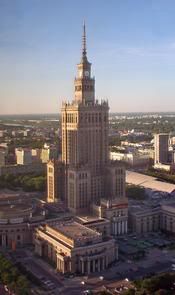




 my feed